Remote machines can enter a radiation area, inspect equipment, or move a tool without putting a worker in that space. That can lower exposure, but it doesn't make a nuclear site safe by itself.
Quick read
- Remote inspection keeps people farther from radiation sources
- A robot still needs a trained operator and a recovery plan
- Safety gains depend on tested hardware, software, and procedures
Where robots can reduce risk
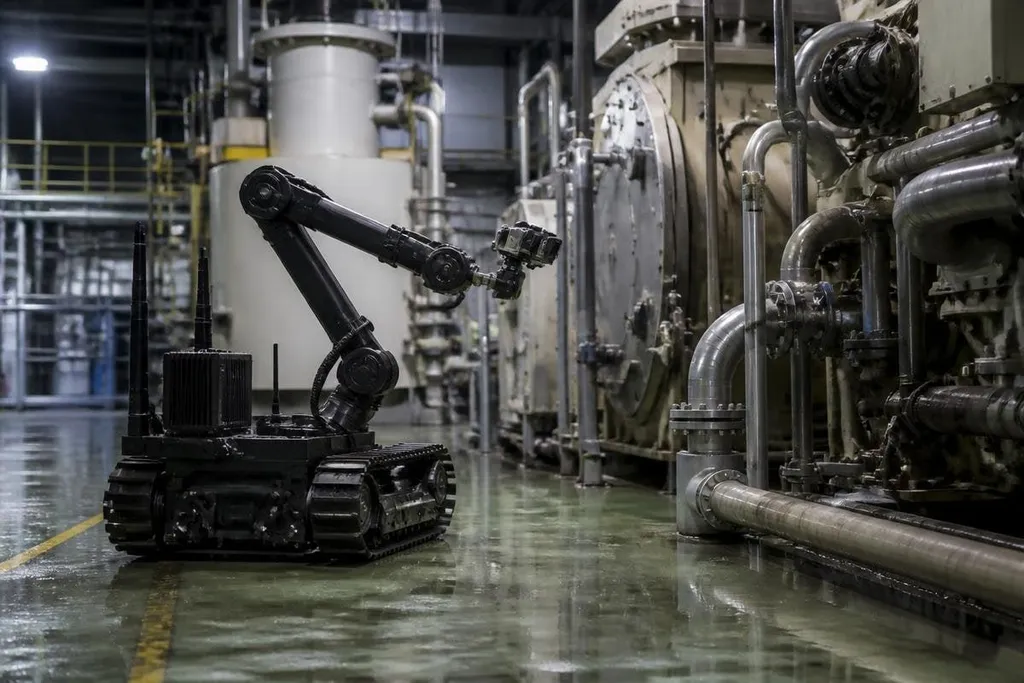
Nuclear work often involves places that are hard to reach, hard to see, or unsafe to enter for long periods. A tracked robot can carry a camera through a narrow passage, while a robotic arm can hold a tool near equipment that needs inspection.
The benefit is measured in worker exposure, task time, and the number of entries into a controlled area. A camera image can help a team decide what to do next without sending a person in for an early check. That only works when the image is clear enough and the robot can return safely.
The same machines can handle repetitive checks. A machine may follow the same route around a pipe, tank, or shielded room and record changes over time. A repeatable route gives engineers a better basis for comparing inspections than memory or a single visit.
Radiation is only one problem
Radiation can damage electronics, sensors, cables, and batteries.
Heat, dust, water, tight spaces, poor radio links, and damaged floors can create separate failures. Equipment built for a clean factory may stop working after a short time in a nuclear work area.
The control link matters too. If a robot loses contact with its operator, it needs a known response. It may stop, return along its route, or wait for recovery. The right choice depends on the site and the task, so a general claim about “autonomy” says very little on its own.
When a machine stops, it can become another obstacle in a narrow room, especially if it carries a tool or sits near contaminated equipment. The team needs a way to lift, tow, isolate, or reach it without creating a larger hazard.
Automation does not replace nuclear judgment
The machine can collect images and sensor readings. People still decide what those readings mean, what level of risk is acceptable, and which work can proceed.
That division matters because inspection data can be incomplete. A camera may miss a crack behind a pipe. A sensor may drift. Software may label a surface as clear when the view is blocked by dust or water. Each system needs a known failure limit and a process for checking doubtful results.
For this nuclear safety question, the missing proof is concrete: a named plant, robot, test date, worker-exposure measure, and record of what happened when the system failed. No source pack was supplied here, so these points describe the checks a project would need, not a real deployment or measured result. Robot 24 can help you compare robotics claims with the machines, sites, and tests behind them.
I’d support robotic work in nuclear sites when it cuts human exposure without hiding the remaining risks. One that fails safely and can be recovered is more useful than one that performs a smooth demonstration under controlled conditions.
What a serious project must show
The practical test is not whether the robot can move. It is whether the full team can use it safely when the site is difficult and the machine behaves badly.
- Test the route: Run the robot through the real space, including poor surfaces, tight turns, and blocked views.
- Measure exposure: Record how many entries and operator hours the system removes from the task.
- Check the link: Test lost communication, delayed video, and loss of power before live work.
- Plan recovery: Keep tools and lifting points ready for a robot that stops in the work area.
- Verify inspection data: Compare robot readings with a known reference and set a process for doubtful results.
- Set the limit: State the radiation, heat, water, and battery conditions where the robot must stop.
These checks also show where a smaller system may be the better choice. A compact crawler could inspect a narrow route, while a larger robot may carry more equipment but create a harder recovery problem.
The next useful result will be a measured task record: exposure avoided, inspection coverage, failures, recovery time, and the conditions that caused each failure. Until project teams publish those numbers, robots look like a safety tool with real promise, not a safety guarantee.